

What Is the Difference Between a Home Equity Loan and a HELOC?
Minute Read

Today, homeowners have more financial opportunities than ever before. Rising property values are creating a powerful source—home equity. Tapping into that value, you're likely to find two options—a home equity loan and a home equity line of credit (HELOC). You can use both to borrow against your home, but they work in different ways.
This guide from Members 1st Federal Credit Union helps you confidently choose between a home equity loan and a HELOC, so you can select the right financial tool for your specific goals.
Key Takeaways
Both options unlock your home's value, but they serve different needs. Keep these essential points in mind:
-
A home equity loan gives you a lump sum with a fixed interest rate and predictable payments.
-
A HELOC offers flexible access to funds with a variable interest rate.
-
Loans work well for one-time expenses, while HELOCs suit ongoing or uncertain costs.
-
Your home serves as collateral for both options.
-
Credit unions offer competitive rates with personalized guidance.
What Is Home Equity?
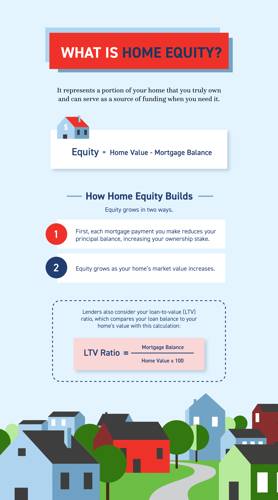
Home equity is one of the most valuable financial tools available to homeowners. It represents a portion of your home that you truly own and can serve as a source of funding when you need it.
Think of equity as an asset that grows over time. In recent years, rising home values have significantly increased this asset, with U.S. homeowners now holding over $11.5 trillion in tappable equity. On average, that translates to about $212,000 per homeowner. Equity is calculated using this formula:
Equity = Home Value - Mortgage Balance
For example, if your home is worth $350,000 and you owe $200,000 on your mortgage, you have $150,000 in equity.
How Home Equity Builds
Equity grows in two ways. First, each mortgage payment you make reduces your principal balance, increasing your ownership stake. Second, equity grows as your home’s market value increases. When local home values rise, the property may become worth more than its original purchase price. Even without extra mortgage payments, appreciation can expand available equity.
Lenders also consider your loan-to-value (LTV) ratio, which compares your loan balance to your home's value with this calculation:
LTV Ratio = Mortgage Balance / Home Value x 100
For instance, if you still owe $200,000 on a $400,000 home, your LTV is 50%. Lower LTV ratios typically give you higher borrowing limits and better terms. Understanding equity and LTV ratios creates the foundation you'll use to compare home equity loans and HELOCs.
The Two Paths to Borrowing: Loan vs. Line of Credit
Using your home's equity, you can generally choose between two loan paths—the home equity loan or a HELOC. Both options use your home as collateral, which often results in lower interest rates than with unsecured borrowing, such as personal loans or credit cards. Still, the repayment structure, rates and borrowing flexibility differ significantly:
1. A Home Equity Loan
A home equity loan is a lump-sum option that functions similarly to a standard installment loan. You get the full loan amount up front. From there, you repay it in equal monthly payments over a fixed term, often with a fixed interest rate, which means your payment stays consistent.
This predictability simplifies budget planning, as you know exactly how much you owe each month and when the loan will be paid off. For example, if you borrow $50,000 to remodel your kitchen, you'll receive the entire amount at closing. Then, you repay it in steady installments.
2. A Home Equity Line of Credit
A HELOC is a flexible option that lets you borrow against your equity as needed, up to a set limit.
Like a credit card, this is a revolving line of credit that lets you draw funds, repay and borrow again during the draw period. During this time, payments may be interest-only, keeping your monthly costs lower without reducing the principal balance. After the draw period ends, the repayment period starts. At this point, you can no longer borrow and must start repaying both the principal and interest.
HELOCs usually have a variable interest rate, meaning your rate and payment can change over time based on market conditions. For example, if you're renovating your home in phases, you might draw funds for each stage rather than taking a single large amount up front.
The Differences at a Glance
Here's a side-by-side comparison to help clarify how these loan options differ:
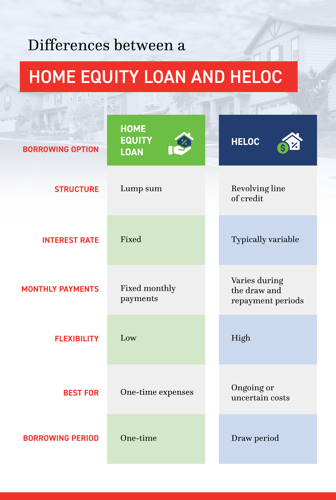
While both options use your home as collateral, choosing between them often comes down to how much flexibility you need and how comfortable you are with changing payments. Your spending discipline is a key decision-maker here. With a HELOC, you need to monitor your balances and repayment. A home equity loan naturally creates more structure because the amount is fixed from the start.
Which Option Is Right for Your Financial Goals?
Choosing between a home equity loan and a HELOC depends less on which product is “better” and more on how you plan to use the funds. The right choice often comes down to budget certainty, borrowing flexibility and personal comfort with changing interest rates.
When a Home Equity Loan Makes Sense
When you know exactly how much money you need for a major expense, a home equity loan may work best.
Imagine preparing for a large improvement project. You've got contractor bids, material estimates and a clear construction timeline, so the cost likely won't change significantly. In this situation, getting a lump sum can simplify everything. Its consistency can reduce stress and make long-term budgeting easier.
In the U.S., home improvement exceeds $500 billion, showing that home improvement is one of the most common reasons homeowners tap into equity. A home equity loan can also help consolidate higher-interest debt. With the average credit card annual percentage rates (APRs) hovering near the 21% mark, replacing revolving debts with a lower fixed-rate home loan can lower your monthly interest costs, creating a clear payoff timeline.
When a HELOC Makes Sense
When you need more flexibility, a HELOC is the better fit.
Consider tracking your long-term renovation project in stages. The initial work may focus on structural repairs, while later phases include cosmetic upgrades or additions. These project costs can shift as material prices change or contractors uncover hidden issues. In this situation, borrowing only what you need at each stage can feel more practical than taking a large sum up front.
Some homeowners also see a HELOC as a backup financial cushion. For example, you can establish a HELOC but leave the balance untouched, because you only pay interest on what you actually use. If there is an unexpected emergency, such as a major roof repair or medical expense, the funds are already available. This gives you peace of mind without the cost of borrowing immediately.
A HELOC can also support you during periods of irregular income. Someone with fluctuating freelance or commission-based earnings may appreciate the ability to borrow and repay flexibly during stronger earning periods. Still, you should prepare for changing monthly payments if rates rise. Financial flexibility can be valuable, but it still requires thoughtful planning and disciplined repayment habits.
Frequently Asked Questions
Home equity borrowing often raises important questions about taxes, costs and long-term financial planning. Understanding these details can help you make informed decisions with confidence.
Is the Interest Tax-Deductible?
In some cases, yes. According to IRS guidelines, the interest you pay on a HELOC or home equity loan can be tax-deductible when you use the funds to buy, build or make a substantial improvement to your home that secures the loan.
For example, if you use a home equity loan to renovate your kitchen, replace a roof or add living space, the interest can potentially qualify for a deduction. However, if you use the funds for unrelated expenses, such as a vacation or personal purchase, the deduction rules can differ.
Because every tax situation is unique, speak with a qualified tax advisor before making decisions based on potential deductions.
What Are the Typical Closing Costs?
Closing costs depend on the type of borrowing product, property details, loan structure and your loan provider. Some lenders charge appraisal fees, title fees, recording costs or administrative expenses during the application process.
Since credit unions are not-for-profit, they often have lower fees or may waive certain fees on a HELOC, though specific closing costs can vary. Trust review costs may still apply for properties held in a trust. Your credit union can walk you through all the estimated expenses before you commit.
Can I Switch From a Variable-Rate HELOC to a Fixed Rate?
Credit unions often offer a fixed-term lock option that lets you convert some or all of your HELOC balance into a fixed-rate loan. This feature helps you balance flexibility with payment stability.
For example, say you initially use a HELOC during a renovation project because costs are uncertain. Later, when your borrowing slows down, you may be able to choose to lock part of the balance into a fixed rate for more predictable monthly payments. This flexibility gives you more control as your financial needs change.
What Happens if I Sell My Home?
When you sell your property, the proceeds from the sale typically pay off your remaining mortgage balance along with any outstanding home equity loan or HELOC balance. Because the home secures the loan, the finances must generally be satisfied before you do a change of ownership.
For example, if you still have a HELOC balance after completing a renovation project, the balance is typically paid at closing. Any remaining funds then go to the seller after all liens and obligations are settled. If you anticipate selling your home in the future, speak with your credit union representative beforehand to ensure you understand their payoff procedures and timing.
How Is a Home Equity Loan or HELOC Different From a Cash-Out Refinance?
A cash-out refinance replaces your existing mortgage with a brand-new mortgage for a larger amount. You get the difference in cash. A home equity loan or HELOC works differently because it typically exists alongside the original mortgage instead of replacing it.
This distinction matters in today's rate environment. Many homeowners have low first-mortgage rates they don't want to lose. With a home equity product through a credit union, you may be able to keep your original mortgage intact while still accessing your available equity.
If you value flexibility, preserving a favorable first mortgage while adding a separate home equity product can offer a more practical solution than refinancing the entire loan structure.
Making Your Choice with Confidence
Home equity can become a valuable financial resource when you use it thoughtfully. Whether you choose a home equity loan or a HELOC, the right option depends on how you use the funds, how predictable your budget needs to be and how comfortable the borrower feels with changing interest rates.
A home equity loan offers structure, consistency and predictable payments. A HELOC gives you flexibility, adaptable borrowing and ongoing access to funds when your needs change. Neither option is universally better. The strongest choice aligns with your goals, timeline and financial habits.
By understanding how each product works, you can approach the decision more confidently. A trusted credit union partner can also help evaluate your options, explain terms and guide you toward a solution that supports your immediate needs and long-term financial well-being.
Federally insured by NCUA. We do business in accordance with the Federal Fair Housing Law and Equal Credit Opportunity Act.
